Cootehall barracks
The Greatest Beer Run Ever: A Memoir of Friendship, Loyalty, and WarCootehall barracks becomes the McGahern children’s home after their mother is taken away to hospital, placing them within the same building as their father’s authority and the routines of police life. The barracks is at once a family dwelling, a workplace, and a symbol of a state whose practical presence in the village is slight.
Setting in Cootehall
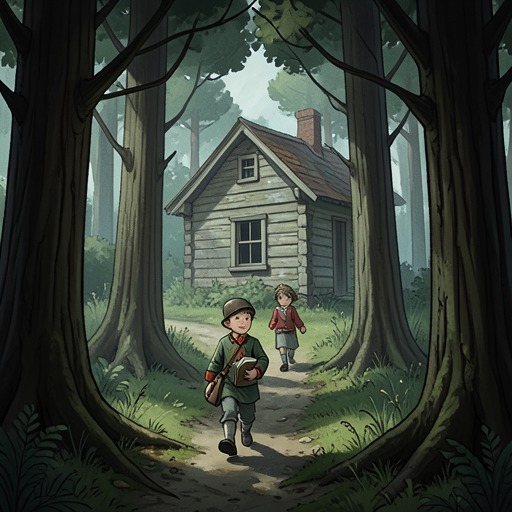
The barracks stands in a village scattered around Henry’s field, where a church, post office, presbytery, two shops, three bars, and a few houses occupy separate sites rather than forming a continuous street. That dispersed layout makes the barracks one institution among a handful of village landmarks, not the centre of a busy civic life.
The building’s living quarters had been uninhabited for so long, apart from the father and a maid, that the children’s voices rang back at them when they shouted. The sound soon irritated their father, who called up from the dayroom and demanded quiet. The house gave the children space to be heard, but that very openness also exposed them to his reprimands.
A household moved into the barracks
When their mother suddenly has to leave, the children are told to behave, cause no trouble, and pray for her; no explanation of where she has gone or why is offered. The house above the bog closes, and all five children move to Cootehall barracks with Bridgie McGovern. The move turns the barracks from the place where their father already lives into the setting of their daily family life.
The change is sharpened by the contrast between their former home and the quarters. At the barracks they are under their father’s immediate care, including his scoldings, sudden rages, and beatings. The narrator recalls that their mother had previously been with them at home and at school, and that the protection she offered had not always been safe for her either. The barracks is therefore not simply new accommodation: it marks the children’s exposure to a household authority from which their mother had partly shielded them.
Rooms, yard, and places of refuge
The living quarters have two entrances: one through the long hallway from the stairs and dayroom, the other through a scullery back door opening onto a small concrete yard. Across the yard stands the father’s small slated workshop; nearby are a water barrel beneath the eaves, an open turf shed, and a slated lavatory. Beyond the shed and lavatory, a rough lawn holds a rhubarb bed.
That yard gathers the children’s fear and their attention to the world around them into the same small space. After beatings, they instinctively run into the darkness of the lavatory. In summer, white butterflies flicker above the rhubarb leaves, and the children try to close their hands around them. The contrast is exact: the dark offers a momentary hiding place, while the bright, shifting butterflies remain just beyond their grasp.
The yard is also the scene of Margaret’s confrontation with their father. When she runs from the house, he pursues her in full uniform; their mother stands in his way but does not stop him. He sends the child spinning into the rhubarb bed, catches her before she reaches the lavatory, and lifts and shakes her. Margaret is too paralysed to kick or cry out. He eventually puts her down without further chastisement. The route from the house to the lavatory, which the children use as refuge after beatings, becomes in this incident the space where their father catches and physically dominates her.
Discipline, institutional purpose, and the river
After the children arrive, the barracks’ domestic life takes on a fixed order. They eat in silence beneath the window, while their father sits in the middle of the room facing the sideboard mirror; a quarrel or stray noise brings a quelling look. Before he goes to the dayroom, he inspects their appearance as they line up for school, often checking behind their ears. The day closes with the Rosary, including a prayer for their absent mother, though the children do not know where she is or what their prayers are for. They then approach their father one by one and kiss him goodnight. The room’s repeated arrangements turn schooling, prayer, and even the end of the day into occasions governed by his oversight.
Outside the family routine, the barracks is described as a largely symbolic presence. Although the Free State was won through armed conflict with Britain, the narrator sees the inherited order as something people did not quite know how to manage; the Catholic Church, meanwhile, dominates public life directly or indirectly. In a climate of suppression, poverty, and fear, Cootehall has little crime and little practical need for a barracks. The guards nevertheless leave their own families to sleep beside a telephone that hardly rings, while people facing sudden death or illness generally go to a priest, or to a doctor if they can afford one.
The barracks is not wholly sealed off from the landscape around it. The father sometimes takes the narrator out on the Tarred Boat, with the boy holding the lines while his father rows. From the river, the narrator can hear his sisters playing back at the barracks. These outings can give the father a reprieve from himself, but a tangled line or slip of the tongue can undo the day’s good humour. For the narrator, the journeys also begin a lasting attachment to the river as a place of escape and solitude. Beside the barracks’ inspections, silence, and enforced household rituals, the river offers a fragile counterspace rather than a permanent release.